Call Recording Compliance
in Australia: What the Law Requires
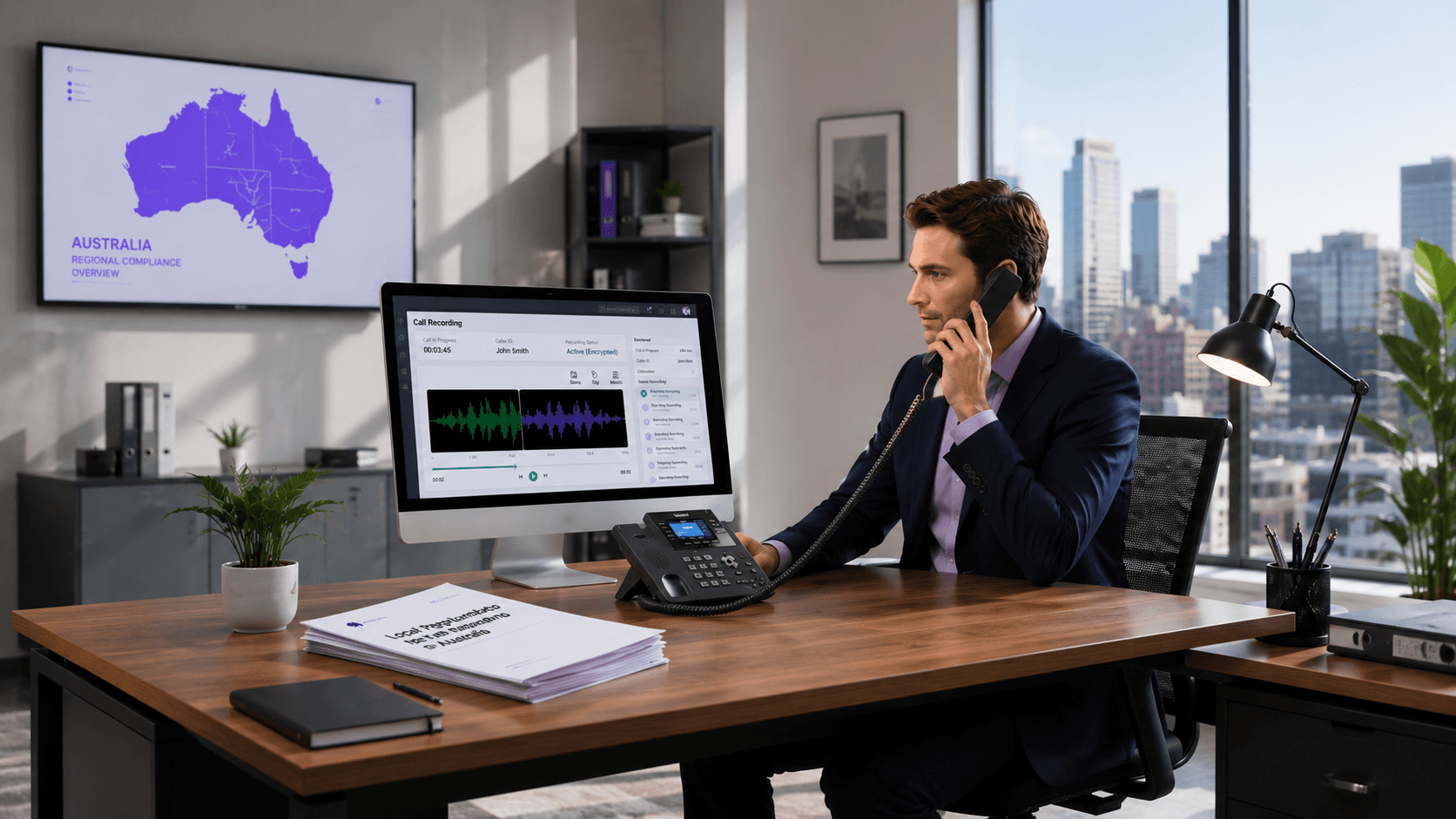
Recording client calls is standard practice at most brokerages, but the law governing that practice is not one law. It is a federal layer and a state layer, and the state layer changes depending on where the client is sitting when the phone rings. By the end of this article, you will know which consent rule applies in each state and territory, how long recorded advice conversations need to be kept, and why recording a call is a different thing from actually reviewing what is in it.
Why This Matters Right Now
Most brokerages started recording calls for a practical reason: training, dispute resolution, or because a phone system came with the feature switched on. Few brokerages started that practice by first checking whether recording was lawful in every state they operate in.
That gap matters more than it used to. Recorded calls are frequently relied on as evidence in disputes where they exist, sometimes referenced in Australian Financial Complaints Authority determinations, and treated by ASIC as part of the advice record a licensee is expected to produce on request. A recording made without the right consent is not just a technical breach. It can be inadmissible in the very dispute it was meant to help resolve, and it can expose the person who made it to a separate offence under state law.
The law itself has not changed dramatically in recent years. What has changed is how much weight is placed on the recording once it exists. A brokerage that has never tested its recording practice against the actual legislation is relying on assumption, not compliance.
Australian states and territories require the consent of every party before a business call can be lawfully recorded
Minimum retention period for personal advice records, including relevant call recordings, under ASIC's record-keeping instrument
Maximum prison term for unlawfully recording a private conversation in Victoria, Queensland and the Northern Territory
Recording a call and being able to prove it was handled correctly are two different things.
Callyx.ai keeps every recorded call organised against your obligations, not just stored.
The Core Obligation: Two Separate Bodies of Law
Two different legal questions sit inside "can we record this call." The first is whether recording it is lawful at all. The second is what a brokerage must do with the recording once it exists. Brokerages that treat these as one question tend to get the first half right and the second half wrong.
The right to record is a state and territory matter, not a federal one. Commonwealth law, through the Telecommunications (Interception and Access) Act, prohibits a third party from intercepting a call in transit without authorisation. That law is aimed at wiretapping, not at a business recording a conversation its own staff member is a party to. Whether a participant can record their own call is governed instead by each state and territory's surveillance or listening device legislation, and the answer is not uniform.
In New South Wales, Western Australia, South Australia, Tasmania and the ACT, the default position under laws such as the Surveillance Devices Act in NSW is that every principal party to the conversation must consent before it can be recorded, with a narrow exception where recording is reasonably necessary to protect the recorder's own lawful interests.
In Victoria, Queensland and the Northern Territory, a person who is a party to the conversation, such as an adviser on the call, can record it without the other party's consent under Victoria's equivalent surveillance law, though publishing or sharing that recording still carries separate restrictions. A national call centre operating across all eight jurisdictions is, in practice, operating under the strictest rule that applies to any client on the line.
| Year | Development |
|---|---|
| 1971 | Queensland enacts the Invasion of Privacy Act, the earliest of the current state listening device laws still in force |
| 1979 | The Telecommunications (Interception and Access) Act (Cth) prohibits unauthorised interception of communications in transit |
| 1991 | Tasmania enacts the Listening Devices Act |
| 1992 | The ACT enacts the Listening Devices Act |
| 1998 | Western Australia enacts the Surveillance Devices Act |
| 1999 | Victoria enacts the Surveillance Devices Act |
| 2007 | NSW and the Northern Territory both enact new Surveillance Devices Acts, replacing earlier listening device laws |
| 2016 | South Australia enacts the Surveillance Devices Act, replacing the 1972 Listening and Surveillance Devices Act |
| 2024 | ASIC's record-keeping instrument sets the seven-year retention rule for personal advice records |
The obligation to keep records sits under the Corporations Act and ASIC's own instruments.
AFSL holders already carry general AFSL obligations to provide services efficiently, honestly and fairly, and to maintain adequate systems for meeting their legal obligations.
Those obligations sit in the Corporations Act itself, which is also where the general foundation for record-keeping expectations begins.
Layered on top of that, ASIC's record-keeping instrument requires personal advice records to be retained for at least seven years.
Where a call recording is genuinely part of that advice record, the same seven-year retention period applies to it, and that obligation continues even after a representative stops being authorised by the licensee.
Consent and retention are not the same requirement, and satisfying one does not satisfy the other. A recording obtained with valid consent still needs to be stored for the right period, in a retrievable format. A recording stored correctly for seven years is still an offence if it was never lawfully consented to in the first place.
Where Brokerages Commonly Fall Short
Treating consent as one national policy
One recurring gap is treating call recording as a single, national policy. A consent script written for a Victorian call centre and used unchanged for NSW or WA clients is likely non-compliant for those calls, because the underlying consent rule is different in those states.
Storage format, not just storage duration
Many brokerages know records need to be kept for years but store recordings in a format, or on a system, that cannot easily produce a specific call on request. Licensees should be able to retrieve a required record promptly when ASIC, AFCA or another authorised body asks for it, not simply confirm that it exists somewhere on a server.
Assuming recording equals monitoring
Recording a call satisfies a record-keeping question. It says nothing about whether anyone reviewed what was said on that call, or whether the advice given matched what the licensee's compliance framework requires. For many firms, the recordings pile up and the compliance risk sitting in unreviewed phone calls grows quietly, because a well-intentioned recording programme has become an unreviewed archive rather than an active safeguard.
Treating disclosure as a formality
A pre-call disclosure such as "this call may be recorded for quality purposes" satisfies the all-party consent requirement in states like NSW only if the other party stays on the line after hearing it, and only if that is genuinely how the brokerage's systems record implied consent. Treating the disclosure as a formality rather than the actual legal basis for recording is a gap that only becomes visible when a recording is challenged.
Most monitoring programmes have a blind spot: the calls nobody reviews.
Callyx.ai automatically monitors 100% of your recorded calls, so nothing sits unreviewed just because volume outpaces your team's time.
Book a DemoWhat Good Looks Like
State-aware consent
A consent approach that varies by state, not a single national script. Staff know which disclosure wording applies to a client's location, and the system prompts the right version rather than relying on memory.
Retrievable storage
Records stored in a format that is searchable by client, date and adviser, not just backed up in bulk. A specific call can be produced promptly when ASIC, AFCA or another authorised body asks for it.
Rolling review
Recorded calls reviewed on a rolling basis against the standard a compliant advice conversation is expected to meet, with findings feeding back into training rather than sitting in a file.
Three separate systems
Consent, storage and monitoring treated as three separate, deliberately designed parts of the same programme, each owned by someone, rather than three assumptions bundled into "we record our calls."
How Callyx.ai Fits
How Callyx.ai fits
Core
Applies consent and disclosure logic aligned to the jurisdiction that governs a call, so the same platform handles an all-party consent state and a participant consent state correctly without staff needing to remember which rule applies where.
Comply
Keeps every recorded call retrievable against your seven-year retention obligation, indexed by client and adviser rather than left as an undifferentiated archive.
Learn
Turns monitored calls into structured training material, closing the loop between what a review finds and what a coaching programme actually addresses.
Across all three, the working principle is the same one that runs through this article: recording a call is the easy part. Being able to show what happened on it, and that it was handled lawfully from the first ring, is the part that actually satisfies a compliance obligation.
Practical Steps
Map your client base against the consent rules that apply
If clients sit in NSW, WA, SA, Tasmania or the ACT, confirm your disclosure and consent process meets the all-party standard, not the lighter participant consent standard used elsewhere.
Audit your recording storage against the seven-year retention rule
Confirm recordings tied to personal advice can be retrieved by client and date, not just proven to exist somewhere in aggregate.
Separate your monitoring workload from your recording volume
If the number of calls being recorded has grown faster than the team reviewing them, that gap is where risk accumulates quietly.
Document your consent basis, not just your consent wording
A script is not evidence of lawful consent on its own; the system also needs to show that the required consent was actually obtained on each call, in the state where it mattered.
Review your workplace surveillance obligations alongside client-facing consent
Recording staff on calls to clients carries its own notification requirements in several states, separate from the client consent question.
Consent, storage and monitoring are three separate problems. Treat them that way and the compliance picture holds together; treat them as one and gaps accumulate quietly.
Summary
Call recording compliance in Australia is not one rule with a single answer. It is a federal record-keeping obligation sitting on top of a state-by-state consent framework that genuinely differs depending on where the client is. Getting consent right in one state and applying it everywhere is one of the more common ways a well-intentioned recording programme becomes a liability rather than a safeguard.
The seven-year retention obligation and the state consent variations are genuine legal requirements. Whether recorded calls are actually reviewed is a separate, practical question that sits alongside them, and a brokerage needs a system that treats all three as distinct rather than assuming one covers the others. Callyx.ai was built around exactly that separation: correct consent handling, retrievable storage, and monitoring that actually keeps pace with call volume.
Your calls are already being recorded. Now make sure that's actually protecting you.
Callyx.ai applies the right consent logic by state, keeps every recording retrievable against your seven-year record-keeping obligation, and monitors 100% of your recorded calls so nothing sits unreviewed. Book a demo to see how it fits your current call recording setup, wherever your clients are calling from.
Book a DemoFrequently Asked Questions
About the Author
Vincent Keogh
Vincent is an operations specialist on the Callyx.ai team, writing for compliance managers and principals on how to get maximum value from recorded calls: across compliance, staff training, and business performance.
Primary Sources
- Corporations Act 2001 (Cth), s.912A
- ASIC Corporations (Record-Keeping Requirements for Australian Financial Services Licensees when Giving Personal Advice) Instrument 2024/508
- Telecommunications (Interception and Access) Act 1979 (Cth)
- Surveillance Devices Act 2007 (NSW)
- Surveillance Devices Act 1999 (Vic)
- Invasion of Privacy Act 1971 (Qld), s.43
- Surveillance Devices Act 1998 (WA)
- Surveillance Devices Act 2016 (SA)
- Listening Devices Act 1991 (Tas)
- Listening Devices Act 1992 (ACT)
- Surveillance Devices Act 2007 (NT)
Related Articles
This article provides general information only and does not constitute legal advice. Consent and surveillance device requirements vary by state and territory and are subject to change. Brokerages should seek advice from a qualified legal professional regarding their specific obligations before relying on any information in this article.
Your calls are already being recorded.
Now make them count.
Recorded advice conversations are reviewed against your compliance criteria, with issues flagged and documented. Less reliance on sampling. Fewer blind spots.