Process Automation
for Insurance Brokers: Where to Start
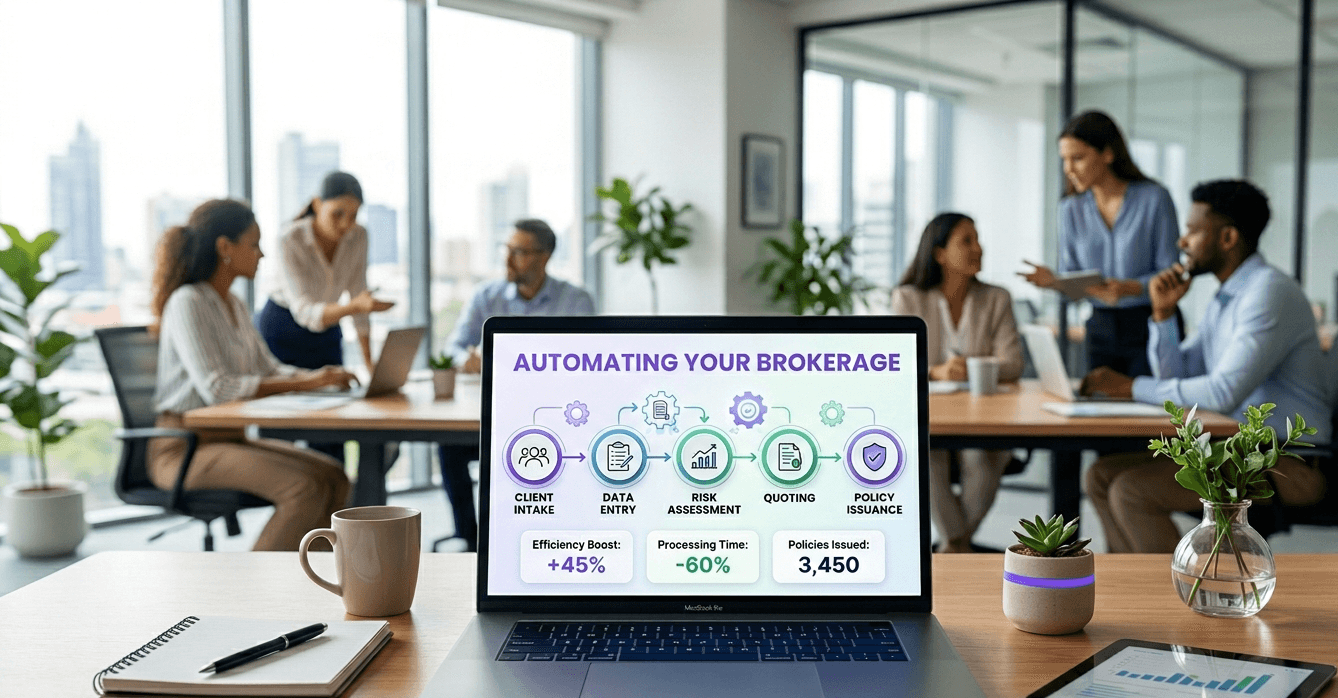
For most insurance brokerages, process automation starts with a clear picture of which tasks are consuming the most time, which of those are genuinely repeatable, and which ones do not require professional judgement to complete consistently. This article provides a practical framework for identifying your highest-value automation opportunities, the five post-call tasks worth targeting first, and the patterns that most often slow automation programmes down in the first year.
What Process Automation Actually Means in a Brokerage
Process automation can involve large-scale IT projects, systems migrations and enterprise RPA deployments. For most insurance brokerages, the more practical starting point is the repeatable work that happens after client interactions.
In a brokerage context, process automation means identifying the tasks that happen after every client interaction and finding the ones that follow a predictable pattern. Post-call note-taking follows a pattern. CRM updates follow a pattern. Compliance flag detection follows a pattern. Performance data capture follows a pattern. These tasks still matter, but they tend to follow structured, repeatable patterns that consume time that could often be returned to client advice, service and follow-up.
A useful starting point is a task audit, before making any software decision. Identify the five or six tasks that happen most frequently and consume the most collective time. Those become the target list. The technology question comes after. See also how productivity bottlenecks accumulate in a financial services business for context on where time actually goes across the working week.
of an insurance agent's or broker's time consumed by administrative tasks (BCG, April 2025)
productivity gains from AI-empowered tools for insurance service and operations staff (BCG, April 2025)
of insurance organisations have successfully scaled AI systems — about two-thirds remain in the pilot stage (BCG, September 2025)
The Five Post-Call Tasks Worth Automating First
For most insurance brokerages, the highest-value automation opportunities sit in the workflow that follows every client call. These five tasks are the most frequent, the most time-intensive, and the most straightforward to automate.
Call summarisation and note-taking
Writing up what was said, what was agreed, and what needs to happen next can easily take several minutes per call. For a team of ten brokers handling eight calls a day each, even five to fifteen minutes of documentation per call can add up quickly. Automated call summarisation captures this from the conversation itself, without requiring the broker to write anything. Automation suitability: high. The task is structured enough for automation, with human review where needed.
CRM updates and record management
After every call, client records need updating: policy status, conversation notes, renewal dates, agreed actions. These updates are predictable in structure but variable in content, which makes them good candidates for automation tools that extract structured data from call transcripts and route it to the right record. Automation suitability: high for structured fields. Human review appropriate for complex or sensitive updates.
Compliance flag detection
Identifying whether a call contained a required disclosure, a relevant advice conversation, or a flag worth reviewing is a pattern-matching task. Rather than relying only on manual review, a system can scan calls against defined criteria and surface the exceptions. Manual sampling approaches cover a fraction of calls. Automated detection can check every recorded call against defined criteria. Automation suitability: very high.
Follow-up scheduling and task creation
Every call generates follow-up tasks: send a document, call back at renewal, chase an insurer, confirm a detail. When follow-up tasks are captured manually after a busy call day, details can be delayed or missed. Automated task creation from call content routes the right action to the right person at the right time. Automation suitability: high for standardised task types.
Performance data capture
Building a picture of how a team is performing on client conversations typically requires listening back to calls and manually recording observations. Automated performance data capture does this continuously and consistently, producing a data set that reflects all conversations rather than a small sample. Automation suitability: high. The data capture is structured; the coaching decision that follows remains human.
Your calls are already being recorded.
Callyx.ai helps automate the post-call workflow from the moment a call ends, including summaries, action items, compliance flags and performance data.
What the Data Shows
The insurance industry's progress on automation is further along than many smaller brokerages may realise, and the evidence on what it delivers is now clear. BCG's April 2025 analysis found that administrative tasks currently consume more than 50% of an insurance agent's or broker's time. In broker-driven channels specifically, BCG found that AI automation of admin tasks, meeting preparation and summarisation, and information access can materially lift productivity and return that time to client engagement. Insurers deploying AI knowledge assistants to service and operations staff have reported productivity gains exceeding 30%.
The scaling picture is more mixed. BCG's September 2025 research found that while about two-thirds of insurance organisations are in the pilot stage, only 7% have successfully scaled AI systems across their operations. The barrier is often not the technology alone. BCG's analysis found that human and organisational factors account for 70% of scaling challenges: unclear priorities, insufficient change management, and automation initiatives disconnected from specific business outcomes.
For smaller brokerages, this is actually useful context. The 7% figure describes large carriers investing tens of millions of dollars in enterprise-wide deployments. A brokerage does not need to scale across an entire organisation. It needs to automate a handful of high-frequency tasks and do it well. That is a very different problem, and a much more tractable one.
The RBA's November 2025 bulletin on technology investment and AI noted that surveyed Australian firms expect AI tools to be labour-saving and productivity-enhancing over the long term, with finance, insurance and professional services firms included in the broader shift toward technology and AI investment. The gains are available. The question is how to capture them without overcomplicating the approach.
Process automation in a brokerage is usually a series of practical decisions about which repeatable tasks can be handled more consistently.
How to Identify Your Highest-Value Automation Opportunities
A natural starting point when thinking about automation is to ask: what software could we buy? The more productive question is: which tasks happen most often and require the least professional judgement?
Three criteria help identify the strongest automation candidates. Frequency: a task that happens once a month is a poor automation target compared to one that happens after every call. Post-call tasks repeat at the same rate as call volume. Predictability: tasks that follow a consistent structure, triggered by a consistent event, are straightforward to automate. Independence from professional judgement: automation works best on tasks where the correct output can be defined in advance. Tasks that require interpreting context, weighing competing considerations, or exercising professional discretion are augmentation opportunities, not automation candidates.
By these three criteria, the post-call workflow is the most compelling automation target in most brokerages. The UK-based Applied Systems 2025 Digital Adoption Report found that half of brokers surveyed were either not using automated workflows or were unsure whether they were, despite 60% identifying integrated processes and productivity as the main business benefit of technology. The gap between knowing the value and capturing it is largely a starting-point problem.
The post-call workflow is the highest-value automation target in most brokerages.
Callyx.ai automatically captures compliance flags, call summaries and performance data from every recorded conversation. Review every recorded call for defined flags, instead of relying only on manual sampling. Works with your existing call recording setup.
Book a DemoWhere Automation Programmes Most Commonly Stall
Getting the starting point right matters more than the tool selection. These are the four patterns that most often slow down or stall automation programmes in the first year.
1. Starting with lower-frequency tasks
Brokerages that begin with infrequent, high-complexity tasks can find it difficult to see returns early. Compliance reporting for annual reviews, for example, is important but infrequent. Post-call documentation happens dozens of times a day. Frequency determines return.
2. Automating an undefined process
If the manual process is inconsistent or poorly defined, automating it locks in the inconsistency. Before deploying any tool, define the desired output clearly. What should a call summary contain? What constitutes a compliance flag? What triggers a follow-up task? The tool works best when the desired output has already been clearly defined.
3. Treating automation as an IT project
The brokerages that get the most from process automation treat it as an operations decision, not a systems decision. The people closest to the daily workflow are best placed to identify what should be automated and whether the output is correct. IT involvement matters for integration and security, but the business case and the quality check belong with the team.
4. Building automation without the compliance layer
Process automation and compliance documentation often work best when they are designed together. Each automated post-call summary can support the compliance record. Each automated flag can support supervision and review. Brokerages that design their automation without the compliance layer in mind can find themselves with a second project: going back and rebuilding the audit trail. Building it in from the start can reduce rework and support a more complete, easier-to-review record.
Callyx.ai is built around the post-call workflow.
Compliance flags, call summaries and performance data captured automatically from every recorded call, with the compliance layer built in from the start.
Process Automation and Compliance Documentation
The relationship between process automation and compliance is not incidental. For an AFSL holder, every client call is a potential compliance event: a disclosure may have been required, advice may have been given, a record may need to be retained. Process automation and compliance documentation often work best when they are designed together. The automated approach captures them as a by-product of the same workflow.
This matters for two reasons. First, the coverage question: manual compliance review can reasonably cover only a proportion of conversations. Automated review can check every recorded call against defined criteria. Second, the timeliness question: when compliance evidence is assembled reactively, ahead of a complaint or audit, the record may not reflect the full picture. When it is built continuously as calls happen, the record is more current and more complete.
McKinsey has noted that gen AI and agentic AI are now capable of automating more complex insurance workflows, including those involving unstructured data and multi-step reasoning. For compliance applications, this supports a move beyond simple keyword matching toward more nuanced flag detection, provided the workflow, data and governance are well designed.
For brokerages thinking about where to start with automation, the post-call compliance workflow is the answer that justifies itself twice: once as a productivity gain and once as a risk management improvement.
Summary
Process automation in an insurance brokerage often starts with the post-call workflow. It is one of the most frequent, predictable and least judgement-dependent parts of the daily operation, and it sits within the broader administrative workload that currently consumes more than half of many brokers' available time.
The framework is straightforward: identify the tasks that happen most often, verify they do not require professional judgement at every step, define the correct output, and then select a tool that can execute it reliably.
It is worth considering the compliance layer from the start. Automating post-call documentation without building in the compliance record can create a second project later. The brokerages that get the most from automation build the compliance and the operational workflow together from the start. A practical approach is to define the task list before choosing the technology.
Frequently Asked Questions
About the Author
Julia Thomson
Julia is a business strategist on the Callyx.ai team. She writes about how businesses can use call intelligence to improve productivity and reclaim time for the work that matters.
Primary Sources
- BCG: How Insurers Can Supercharge Their Strategy with AI, April 2025
- BCG: Insurance Leads AI Adoption. Now It's Time to Scale, September 2025
- McKinsey: The Future of AI in the Insurance Industry, July 2025
- Applied Systems UK: How Automated Insurance Processes Help Brokers Work Smarter, 2025
- RBA Bulletin: Technology Investment and AI: What Are Firms Telling Us? November 2025
Related Articles
This article is for general informational purposes only and does not constitute legal, financial or compliance advice. The information provided reflects the authors' understanding of general business and operational practices in the Australian financial services industry and is not a substitute for professional advice tailored to your specific circumstances. Readers should obtain independent advice regarding their obligations under the Corporations Act 2001 (Cth) and any applicable ASIC regulatory guidance.
Your calls are already being recorded.
Now make them count.
Recorded advice conversations are reviewed against your compliance criteria, with issues flagged and documented. Less reliance on sampling. Fewer blind spots.