Speech Analytics: What It Is and How Insurance Brokers Can Use It
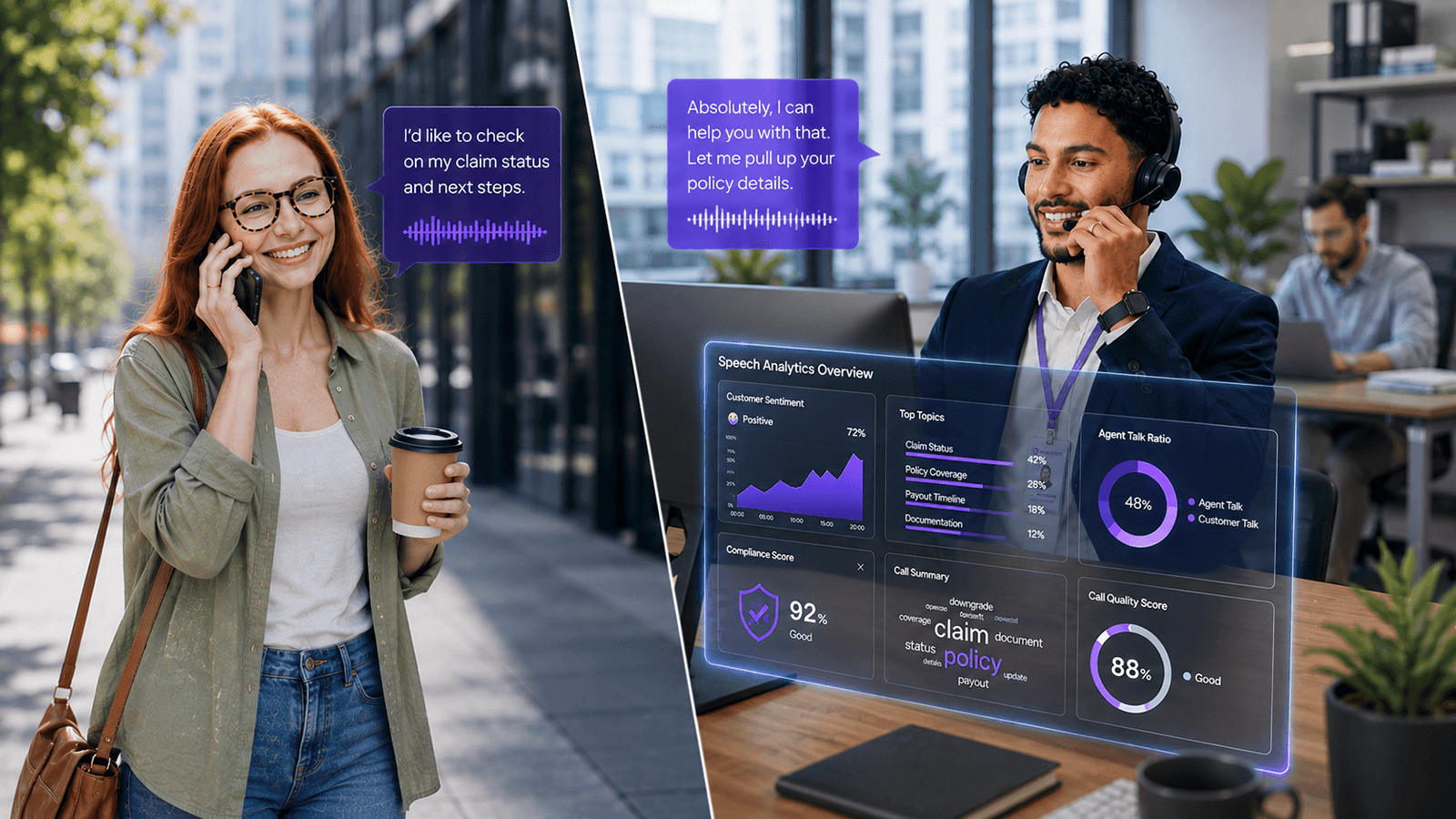
Speech analytics is the technology that turns recorded calls into structured, searchable data on what was actually said, not just a transcript of it. This article explains what separates speech analytics from transcription, the insights it surfaces that manual call review typically misses, and how a brokerage can evaluate it against the standards a regulated financial services environment requires. It also looks at where the technology fits alongside training and quality assurance programmes a brokerage may already have in place, rather than treating it as a separate initiative on top of them. By the end, a broker principal or compliance manager will know what to look for in a speech analytics platform and how to evaluate a vendor's claims against their own calls before committing to one.
Why This Matters Right Now
Speech analytics started in contact centres, where the volume of calls made it impractical for a QA team to listen to more than a small slice of them. It has since expanded into other sectors that share the same volume problem, including financial services, because the underlying condition is identical: a high volume of calls, most of which never get reviewed by a person.
That same gap applies to an insurance brokerage in a specific way. Advice conversations can carry value across at least three areas at once: training, monitoring and client intelligence. The practical constraint is the one contact centres hit first: there are only so many hours available to listen to calls one at a time.
Recording a call is only half of this technology. Where a call is recorded, a transcript can usually be produced automatically. What is typically missing is the analytics layer built on top of that text and audio, the part that surfaces patterns rather than simply making a recording searchable.
Understanding that distinction, and what manual review typically leaves out by comparison, is the starting point for evaluating this category of technology. The rest of this article works through that comparison in practical terms: what a transcript-only setup misses, what a properly evaluated speech analytics platform should be able to show for itself, and what questions are worth asking before choosing one.
Share of contact centre conversations McKinsey found manual QA processes are often limited to reviewing (McKinsey, 2024)
Accuracy McKinsey's 2024 analysis estimates a largely automated QA process could reach, against 70 to 80 percent for manual scoring
Share of contact centre agents who, per SQM Group research, do not believe their QA programme helps improve CSAT or first-call resolution
Your calls already hold this data
Callyx.ai turns your recorded calls into structured, searchable insight, not just a transcript.
The Core Problem: Transcription Is Not Analytics
A transcript is a written account of a call. It tells a manager, word for word, what was said. That has real value: it is searchable, and a manager can pull it up to see what was said if a client conversation is later queried. But a transcript is passive. Someone still has to read it, or listen to the original recording, to find out whether the call went well, whether a disclosure was made properly, or whether a client sounded uncertain about the advice they were given.
Speech analytics does something different. It applies natural language processing and acoustic analysis to recorded calls automatically, scoring things like talk-to-listen ratio, sentiment, script and disclosure adherence, and the specific language patterns that separate a strong advice conversation from a weak one. Where transcription answers "what was said," analytics answers "what happened," and can do it at a scale no manager sampling calls by hand could match.
This distinction matters because most brokerages that believe they have visibility into their calls actually only have the first half. A searchable archive of transcripts feels like operational coverage. It is not the same as knowing, without listening to a single recording, which conversations this week need a manager's attention and why, or being able to say with any confidence how a whole team is performing rather than the handful of brokers whose calls happened to get picked.
Consider what happens when a client calls to query a premium increase. A transcript search can confirm, after the fact, that the call happened and roughly what was discussed if someone thinks to look for it. A platform built for same-day flags can instead surface, on the day, that the call carried elevated frustration language and ended without a clear resolution, so a manager knows to follow up before the client calls a competitor instead. The transcript is a useful lookback once someone knows to search for it. A same-day flag is a signal at the time it matters.
What Manual Review Misses
Contact centre research from McKinsey and SQM Group finds that manual QA programmes, even well-run ones, typically cover only a small fraction of total call volume. That is not a criticism of the person running it: there are only so many hours in a working week, and listening to full calls is slow. For example, a single fifteen-minute advice call takes about fifteen minutes to review properly, longer if notes are being taken, so a manager fitting reviews in around other responsibilities can realistically get through a handful of calls a week, not the hundreds a growing team generates over the same period. The limitation is structural, not personal: a larger or more disciplined review process can push the ceiling higher, but it does not remove the underlying maths of listening to full calls one at a time.
Here is what tends to fall through the gap when review depends on which calls a manager happens to pick:
Talk-to-listen ratio at scale
One broker dominating a client conversation is a coaching note. The same pattern across an entire team, invisible until every call is measured the same way, is a training gap.
Sentiment shifts within a single call
A client who starts a call frustrated and ends it satisfied looks identical to a flat, unremarkable call in a transcript. Acoustic and language analysis can tell the two apart.
Disclosure language consistency
Whether a firm's own required talking points were covered, and in the way the firm intends, across hundreds of calls rather than a sample of, say, ten calls a manager reviewed this month.
Early signals that a client may be considering leaving
Hesitation, repeated questions about cost, or comparison shopping language are the kind of patterns that can show up in calls before a client churns, though not every instance will end that way.
The behaviours that separate strong performers from the rest of the team
Replicating what a top performer does tends to depend on knowing, specifically, what that person does differently across enough real conversations to find the pattern, not the handful a manual sample happens to capture.
None of this means a manual programme is being run badly. It means sampling, however careful, is measuring a fraction of the picture and generalising from it.
Coverage changes what you can see
Manual call review typically covers only a small share of conversations, then generalises from there. Callyx.ai analyses your recorded calls, so patterns show up before they become problems.
Book a DemoWhat Good Looks Like: Three Things at Once
Speech analytics is not a training tool, a monitoring tool, or a client intelligence tool on its own. Done properly, it draws on the same underlying data for all three, because a single call can carry signals relevant to each at once.
For training and coaching
Analytics turns coaching from a matter of impression into a matter of pattern. Instead of a manager's general sense that one broker "seems to handle objections well," the specific language and structure that broker uses becomes visible across every call they have taken. It is the same shift that moves quality assurance beyond random call sampling: broader coverage makes patterns far easier to see than a small sample allows.
For monitoring
The value is consistency rather than depth. A programme built on listening to a sample of calls each month shows that some review is happening. A programme built on automated analysis of every call produces a more complete, consistent operational record of that review, which is a different picture to work from than a sample, though what any of it means for a firm's own compliance framework depends on that firm's specific obligations. Broader coverage also removes a specific kind of risk: the possibility that the one call with a genuine issue is simply not among the calls a manager happened to pick that month. McKinsey's research includes one relevant data point here: a financial services company that deployed generative AI in its quality assurance process reported more than 90 percent accuracy across key quality parameters, and McKinsey identified further initiatives from that deployment that could save 25 to 30 percent on contact centre costs.
For client intelligence
Analytics surfaces the things clients say to brokers that never make it into a CRM note: hesitations about price, comparisons with a competitor, or the specific phrasing that tends to precede a client deciding not to renew. That kind of signal may not surface automatically in a transcript search unless someone already knows to look for it. A principal reviewing renewal risk at a portfolio level, rather than one client at a time, gets a materially different picture when that signal is aggregated across the whole book rather than caught occasionally by an attentive broker. The same underlying data can also feed back into how a brokerage prices, packages or communicates about renewals, since it shows what clients are actually asking about rather than what a survey assumes they care about.
The common thread across all three is coverage. A brokerage does not need three separate systems to get training insight, consistent monitoring and client intelligence. It needs one layer of analysis applied consistently to calls that are already being recorded.
How Callyx.ai Fits
Built around insurance advice conversations
Callyx.ai is built around the language and structure of insurance advice calls.
Connects to what you already record
Callyx.ai is designed to connect to call recordings a brokerage already has, as part of its standard integration approach.
One dataset, three uses
Coaching, monitoring and client intelligence all draw on data from the same recorded calls, so a brokerage is not paying for or maintaining three disconnected tools.
Evaluating and Adopting Speech Analytics: Practical Steps
Start with what is already being recorded
Most brokerages do not need new recording infrastructure to begin. Confirm what calls are currently captured and stored, across which lines and which staff, before evaluating any platform. Gaps in recording coverage are worth fixing first, since analytics can only work with calls that exist, and a partial recording setup will always produce a partial picture no matter how good the analytics layer on top of it is.
Ask a vendor to score a sample of your own calls before signing
A calibration run against real advice conversations, not a generic demo built on retail or telecom call data, is the only reliable way to judge whether a platform's scoring holds up in an insurance context. Compare its output against what a manager listening to the same calls would conclude, and ask the vendor to explain any calls where the two disagree.
Check how the same data serves training and compliance
A platform that only produces compliance flags, or only produces coaching notes, is solving half the problem. Ask specifically how the two connect, whether a manager can move from a coaching insight to the underlying call without switching systems, and whether the same scoring logic is used for both purposes or two separate models bolted together.
Set a coverage target, not a sampling target
The evaluation question is not "how many more calls can we review." It is "what happens once every call is reviewed the same way." A platform's value shows up in what changes when coverage moves from a few percent to effectively all of it.
Plan for the coaching conversation, not just the score
A dashboard full of scored calls does nothing on its own. Build the review cadence with managers before rollout, including who looks at flagged calls, how often, and what happens after a pattern is identified, so the data has somewhere to go rather than accumulating unread.
None of these steps require a brokerage to change how it operates before evaluating the technology. They require confirming that the technology performs on real advice calls, not a generic script, and that the people who will act on its output are part of the rollout from the start rather than handed a finished dashboard afterward.
Summary
Speech analytics closes the gap between having a recorded call and knowing what happened on it. Transcription tells a manager what was said, one call at a time, if someone has time to look. Analytics scores every call the same way, automatically, and surfaces the patterns that manual review, however diligent, only sees in fragments.
For a brokerage, that single shift changes three things that usually sit in separate conversations: how staff are coached, how consistently monitoring actually happens, and how much is actually known about what clients are telling brokers on the phone. Those three areas are often managed by different people using different tools, when in reality they are three views of the same underlying data. Callyx.ai applies that analysis to calls a brokerage is already recording, without a parallel system to maintain and without asking a manager to choose which calls are worth their limited time.
The starting point is not a new recording programme, and it is not a wholesale change to how the team operates day to day. It is asking a simple question about the calls already being captured: what would they show if every single one of them was reviewed the same way, rather than the small sample that happens to get a manager's attention this week.
Frequently Asked Questions
About the Author
Vincent Keogh
Vincent is an operations specialist on the Callyx.ai team, writing for compliance managers and principals on how to get maximum value from recorded calls: across compliance, staff training, and business performance.
Related Articles
Your calls are already being recorded.
Now make them count.
Recorded advice conversations are reviewed against your compliance criteria, with issues flagged and documented. Less reliance on sampling. Fewer blind spots.