Automating the Admin That Follows Every Client Call
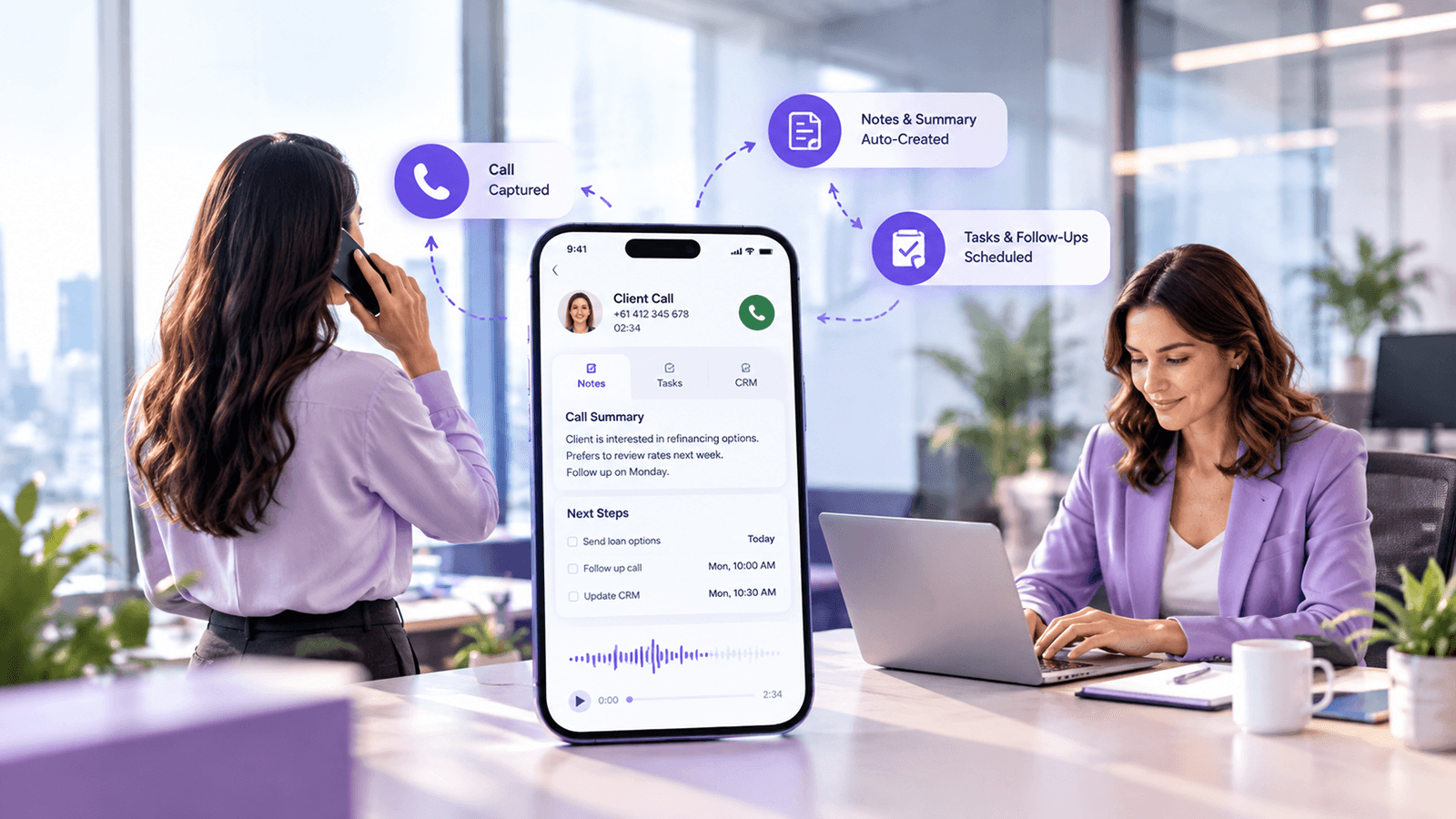
Every client call in a brokerage is followed by a short sequence of administrative tasks, and it is one of the more predictable parts of the working day, tending to grow with call volume. This article follows a representative six-step sequence from end to end: which of those steps can be automated with tools available today, which still need a broker's judgement, and the three questions that separate the two. It includes an illustrative worked example, built from stated assumptions, showing how the sequence compounds across a team over a month. It closes with a sequencing approach designed so the first change is delivering measurable time back before the second one starts.
Why This Matters Right Now
The administrative sequence that follows a client call is one of the more predictable blocks of work in a brokerage week, and it is among the few that tend to grow in step with conversations rather than ahead of or behind them. Take on a new scheme, add a broker, move into renewal season, and call volume rises. File notes, system updates and follow-up tasks generally rise with it. How closely they track call volume depends on call mix, since a renewal and a certificate request do not create the same amount of work, which is an argument for measuring the ratio rather than assuming it.
The scale of the administrative layer is documented at industry level. Boston Consulting Group's April 2025 analysis of AI in insurance found that administrative tasks consume more than 50% of an agent's or a broker's time, which limits the opportunity available for client engagement and business development. That figure covers the whole administrative category across agent and broker-driven channels rather than post-call work specifically, so it sizes the field this sequence sits inside rather than the sequence itself. It remains the most useful industry number available on the question, and what it says is that the administrative layer is comparable in size to the client work it supports rather than a margin around the edges of it.
Post-call work is also, in many brokerages, the last part of that layer to get attention. There are sound reasons for that, and none of them is neglect. The work rarely fails loudly: a file note written at 6pm instead of 2pm still gets written, so nothing escalates and nothing appears on a report. It is never the most urgent item on the desk, because a client waiting on the phone usually outranks a client whose call finished twenty minutes ago. And it is genuinely hard to see, since where the phone time goes in a brokerage day is not something a phone system can report on once the call has ended.
What has changed is the cost of doing something about it. The tools that produce a structured record from a conversation are now ordinary rather than experimental, they work on recordings a brokerage is already making, and they can be introduced one step at a time rather than as a systems project. That combination is new, and it puts the most repetitive sequence in the business within reach of a change that does not require anyone to work differently on the phone.
The Sequence That Follows a Client Call
A client call commonly generates a chain of six tasks. The six below are a representative sequence rather than a universal one: which of them a given call requires depends on the firm's own process and on what was discussed. They tend to read as one job, which is part of why the chain is rarely priced as six, and each has a different owner, a different system and a different amount of judgement attached.
The file note
A written record of what was discussed, what was agreed and what the broker advised. This is often the longest step and the one that carries the most weight later, because it is the record of the conversation itself, and a complaint, a renewal review or a compliance review may all turn on what it says. It also degrades fastest under time pressure, since a note written from memory at the end of the day is working from less than a note written at the end of the call.
The system update
Policy status, cover changes, renewal dates, contact details, a change in the client's circumstances. Some of these are structured fields with one correct value. Others are free-text summaries that depend on how the broker read the conversation. The two sit in the same screen and get treated as one task, which matters when deciding what can be automated.
The follow-up task
Nearly every call ends with an action: send a certificate, chase an insurer, obtain a valuation, call back once the client has spoken to their accountant. Creating that task takes seconds. Remembering to create it, after four more calls, is the part that varies.
The diary entry
The next scheduled contact. Different from a follow-up task because it is a decision about timing rather than an action, and the right date depends on what the broker understood about the client's position.
The confirming email
Not every call needs one. Those that do tend to be the ones that matter most, because a client who has just agreed to a cover change or received advice on a premium movement is the client most likely to want it in writing. This step is also the one the client actually experiences, so its timing carries a service consequence the other five do not.
The handover
Some calls end with work for somebody else: a claims officer, an account executive, an administrator. Handing it over means transferring enough context that the second person does not have to ring the client back to establish what the first conversation covered.
One part of this chain can already run without a person, and it is worth naming because it shows the pattern. On MaxoTel, once call recording has been enabled, inbound and outbound calls are recorded by default, with settings available to change that globally, by extension or on a single call.
With recording backup switched on, recordings upload to Google Drive, Dropbox or FTP.
Each call detail record the system exports also carries a field showing whether a recording exists for that call, available as CSV or JSON. So the conversation itself can be captured and retrieved without anyone deciding to capture it, and the call record can tell you which calls have one. What the recording does not do is read itself into a note, a field update or a task, and three of the six steps also draw on information the conversation never contained. That gap, between a conversation that is captured and a record that is hand-made, is where the sequence sits.
Everything the record needs was said on the call.
Callyx.ai turns each recorded call into a transcript, summary and extracted action items, without adding a manual transcription step.
Where the Sequence Is Hardest to Hold
None of the difficulty here is about effort or capability. It comes from how the six steps are distributed, and the pattern is consistent enough across firms to be worth naming.
Six tasks that present as one job
Because the sequence runs as a single stretch of work after a call, it tends to be estimated as a single number, or more often not estimated at all. Steps with very different automation potential get bundled together and assessed as one, which can make the whole sequence look harder to change than it is.
The work is never the urgent thing in the moment
A live client generally outranks a finished one. When call volume rises, the sequence is what absorbs the pressure, which means it is typically completed late in the day or in a block at the end of the week, when recall of each conversation is weakest.
The steps live in different systems
The note goes to one place, the task to another, the diary entry to a third, the email to a fourth. Even where each individual step is quick, moving between four screens for every call adds a real cost that none of the four systems records.
Quality can vary with the hour rather than the broker
The same person writing the same kind of note at 9am and at 5.30pm may produce different levels of detail, which is a function of the schedule rather than the standard. That variation is hard to see without reading the notes side by side, and it tends to show up later, when a file is being relied on.
There is usually no record of how long it took
A CRM records that the note exists, not the minutes spent producing it. Some systems can be configured to timestamp task start and finish, and that is worth checking before assuming the data is absent. Without it, a brokerage can demonstrate the work happened and still have no basis for saying what it cost, which makes the case for changing it hard to build.
Telling What Can Be Automated From What Still Needs a Person
Three questions separate the two, and they can be applied to each of the six steps in turn rather than to the sequence as a whole. This is the part that decides the order of work later.
Is the correct output defined before the call happens? A file note has a form a firm can specify in advance: what was discussed, what was agreed, what was advised, what happens next. A decision about when to next contact a client does not. The first is a production task. The second is a judgement that happens to produce a short piece of text.
Does the step draw only on the conversation, or on information outside it? Everything needed for a file note and for most structured field updates was said on the call. Choosing a diary date draws on the broker's wider knowledge of the client, the portfolio and the market, none of which the recording contains.
What does a wrong output cost relative to reviewing it? An inaccurate summary is visible on a quick read and costs seconds to correct. An email sent to a client with the wrong cover position costs considerably more than the time saved by sending it unread. Where review is cheap relative to error, automation earns its place. Where it is not, the step wants a person in it.
Applied to the six steps, the answers divide into three groups rather than two.
Automate now
The file note is the clearest case, passing all three tests. The structured portion of the system update is the second, covering the fields with one correct value: policy status, renewal date, cover amount, contact details.
Automate the capture, keep the decision
Follow-up tasks and handovers sit here. What the call implied can be extracted from the conversation and presented. Whether it becomes a task, who owns it and how urgent it is remain decisions, though they are considerably faster decisions when the action arrives already drafted rather than being recalled from memory.
Keep with a person
The diary entry and the confirming email both fail the second or third test. The diary date depends on knowledge the recording does not hold. The email is the step the client reads, which makes it the one place in the sequence where the cost of a wrong output exceeds the cost of writing it.
Every figure below is an assumption, not measured data. It is included to show the arithmetic so a firm can run the same structure on its own numbers. The assumptions match those used in the earlier article on measuring the split, so the two sets of figures reconcile.
Assume one broker handling 8 client calls a day, 20 working days in the month, and a team of eight brokers. Assume the six-step sequence takes 6 minutes per call on average, allocated as follows: 2 minutes for the file note, 1.5 minutes for the system update, 0.5 minutes for the follow-up task including any handover, 0.5 minutes for the diary entry, and 1.5 minutes for the confirming email averaged across all calls, since only some require one.
On those assumptions one broker spends 48 minutes a day on the sequence, or 16 hours a month. Across eight brokers that is 128 hours a month, which is roughly three and a half full-time weeks at 38 hours a week.
The second calculation is the one that sets the order of work. Of the 6 minutes, the file note at 2 minutes and the structured portion of the system update at about 1 minute fall into the automate-now group, giving 3 minutes per call. That is 24 minutes per broker per day, 8 hours per broker per month, and about 64 hours a month across a team of eight: a little over a week and a half of capacity, returned without anyone changing how they take a call. The remaining 3 minutes stay where they are, because they are the judgement half.
Both figures move substantially if the assumptions move, which is the argument for measuring the sequence in your own firm rather than estimating it. The structure is what transfers, not the numbers.
The call ends. The record of it does not have to wait.
Callyx.ai transcribes every recorded call and produces a summary and the action items it contained, delivered after the call. The steps that need judgement stay with the broker.
Book a DemoHow Callyx.ai Handles the Documentation Part
Callyx.ai works on the calls a firm already records. Brokers take calls the way they already take them, and the record of what was said and agreed is produced from the conversation rather than written from memory afterwards. That addresses the documentation end of the sequence and leaves the judgement steps untouched.
Core
Every call is transcribed and stored, an AI-generated summary is produced, and action items are extracted and delivered after the call. The summary is the record of what the conversation contained and the action items are what it implied, which together cover the documentation end of the sequence. Core is included in every plan.
Comply
Maps the firm's compliance obligations, monitors disclosures and fee mentions, and applies per-call compliance flags across the whole team rather than a sample of it. The compliance record builds as calls happen rather than being assembled later, which is the point at which documentation and compliance stop being two projects.
Coach
The firm defines what excellent sounds like, and Coach flags missed qualification moments against that definition and produces structured, specific feedback. Where the sequence is running longer for one broker than for the team, this is usually where the reason sits.
Insights
Tracks conversions, retention and referrals, maps the patterns that predict those outcomes, and surfaces objections that went unaddressed. For a capacity decision this is the layer that says whether the time the sequence consumes is producing the outcomes it should.
Results are delivered after every call to an inbox, or to a CRM or practice management system where that connection has been set up, which Callyx.ai lists as a separate integration rather than part of the standard plans. Comply, Coach, Insights and Learn are Professional plan modules, so the mix available to a given firm depends on its plan. Callyx.ai is Australian-owned and runs on Australian data infrastructure.
Sequencing the Work So the First Change Delivers
Running an automation project one step at a time is not a cautious version of doing it properly. It is what the evidence on scaling supports. BCG's September 2025 research found that only 7% of insurers surveyed have brought AI systems to scale, with about two-thirds still in the pilot stage, and that around 70% of the problems in scaling are people, organisational and process issues rather than technical ones. BCG's April analysis points the same way on sequencing, finding that the firms achieving measurable impact concentrate on one area and establish it before moving to the next.
Pick one call type and write the sequence down
Choose the highest-volume conversation in the firm, usually a standard renewal. List every step that currently follows it, including the ones nobody has written down because they are simply understood. Half a page is enough, and it is the only document this project needs.
Put a number on each step for a fortnight
Not a timesheet and not a quarter. Two weeks, one written definition of what complete means, and a clear statement to the team that this sizes the work rather than assessing anyone. A fortnight is long enough to cover a normal spread of calls and short enough to finish before it becomes background admin.
Automate the step that scores highest on the three tests, and only that step
On the assumptions used above it is the file note, and it is the step that scores highest on all three tests, but which step is largest in practice is a question for your own sample rather than an assumption to carry in. Running one change on one call type keeps the thing being tested small enough that its result is readable, which a simultaneous change across four steps would not be.
Confirm the first change delivered before starting the second
Set the measure before you start and read it at a fixed point, four to six weeks out. Useful measures are the proportion of calls with a complete note, the time between a call ending and its record being finished, and the two-week sample re-run on the same definition. A change that cannot be shown to have delivered is not a foundation for the next one.
Design the compliance record into the first change, not the third
The same analysis that produces a file note can raise the compliance flags that call warranted. Building both from one source at the outset avoids a second project later to reconstruct an audit trail, and it costs nothing extra at the point where the first step is being set up.
None of these five steps requires new systems before it can start. They require one call type, a fortnight of attention, and a decision about which single step goes first.
The same question sits behind any process automation decision in a brokerage: which steps have an output you can define before the work starts.
It is also why workflow automation and compliance design are better treated as one question than two, since both are produced from the same conversation.
Summary
The admin that follows a client call is a sequence of about six tasks, and it is one of the more predictable blocks of work in a brokerage, tending to grow with conversations. Treating it as one job makes it look harder to change than it is. Priced step by step, it divides cleanly: the file note and the structured portion of the system update have a correct output that can be defined in advance and drawn entirely from the conversation, which makes them the strongest candidates available. Follow-up tasks and handovers can have their capture automated while the decision stays with a person. Diary entries and client emails belong with the broker, because the first depends on knowledge the recording does not hold and the second is the step the client actually reads.
On the illustrative assumptions used above, the automate-now group accounts for roughly half the sequence, or about 64 hours a month across a team of eight. The number matters less than the method, and the method is to measure the sequence in your own firm, automate the single highest-scoring step first, and confirm it delivered before starting the next. Callyx.ai produces the transcript, the summary and the action items from recordings a firm is already making, which covers the documentation end of the sequence and leaves the judgement steps where they belong.
The same six-step sequence, priced on the illustrative assumptions used above. This compares the sequence under the automate-now, assist and keep-human analysis set out in S04. It describes the class of work, not the output of any one product.
- File note written from memory after the call, 2 minutes, later in the day when volume is high
- Structured fields updated by hand across a second screen, about 1 minute
- Free-text portion of the system update written by the broker, about 0.5 minutes
- Follow-up task created if it is remembered after the next four calls, 0.5 minutes
- Diary date chosen and entered by the broker, 0.5 minutes
- Confirming email drafted from scratch, 1.5 minutes averaged across all calls
- Total: 6 minutes per call, 128 hours a month across a team of eight
- File note produced from the recording as the call ends, 0 minutes of broker time
- Structured fields prepared from the conversation for broker review, with the final update confirmed by the broker, about 0 minutes of composition and a short confirmation
- Free-text portion still written by the broker, about 0.5 minutes
- Action items extracted and presented, with the broker deciding owner and urgency, 0.5 minutes
- Diary date still chosen by the broker, 0.5 minutes
- Confirming email still written and sent by the broker, 1.5 minutes averaged
- Total: 3 minutes per call, 64 hours a month across a team of eight
Frequently Asked Questions
About the Author
Julia Thomson
Julia is a business strategist on the Callyx.ai team. She writes about how businesses can use call intelligence to improve productivity and reclaim time for the work that matters.
Primary Sources
- Boston Consulting Group, How Insurers Can Supercharge Their Strategy with AI, 11 April 2025
- Boston Consulting Group, Insurance Leads in AI Adoption. Now It's Time to Scale., 4 September 2025
- MaxoTel, Call Recording (My Account Portal)
- MaxoTel, Call Recordings Backup
- MaxoTel, API: Call History/CDR Documentation
Related Articles
Your calls are already being recorded.
Now make them count.
Recorded advice conversations are reviewed against your compliance criteria, with issues flagged and documented. Less reliance on sampling. Fewer blind spots.