The Hidden Cost of Manual Call Reviews
in a Growing Brokerage
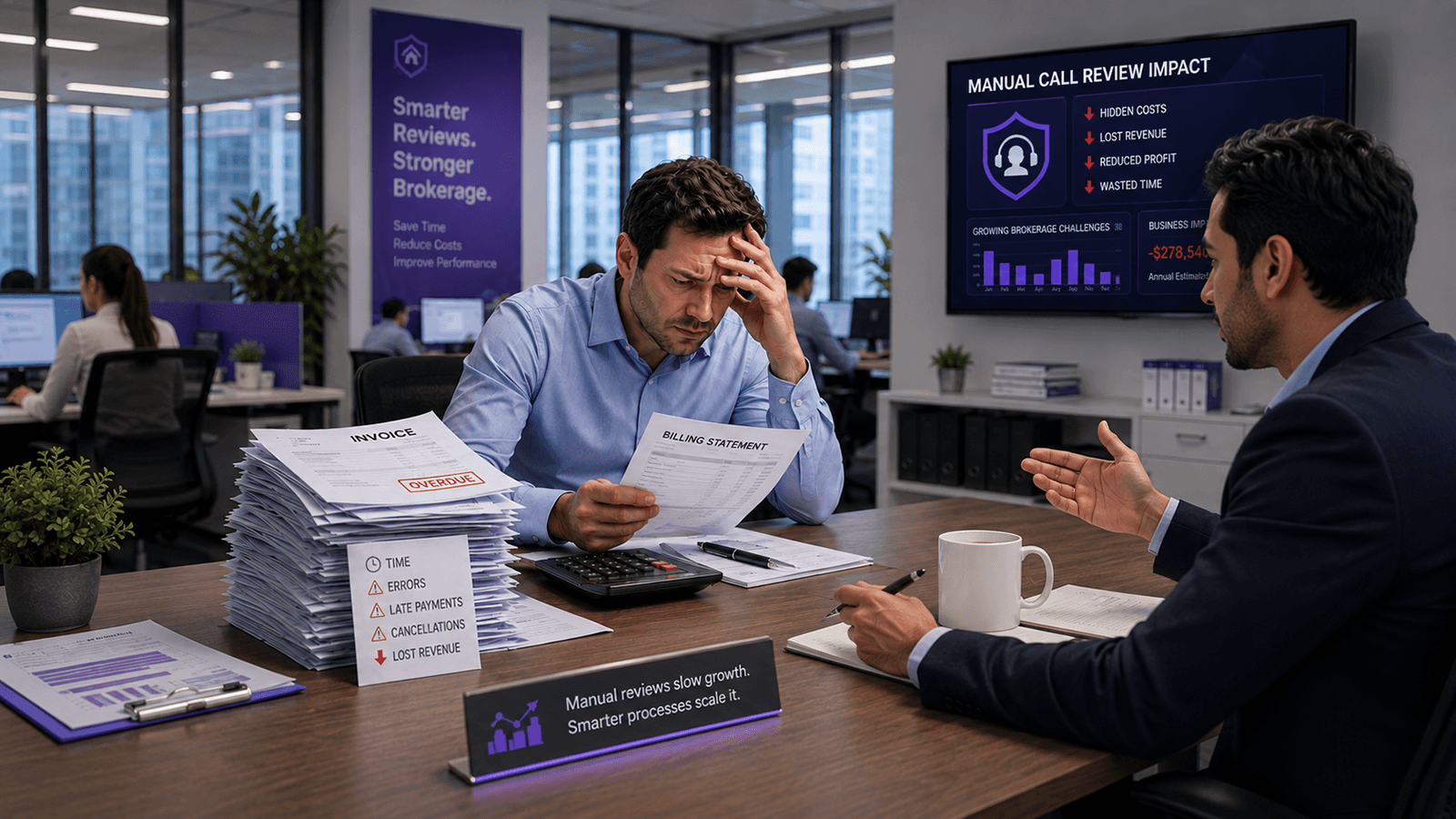
Manual call review has a cost that is easy to overlook. This article builds that number for a growing team, shows why the cost gets worse rather than better as headcount rises, and sets out what a brokerage recovers when it stops sampling calls and starts reviewing all of them. By the end, principals will have a working model for the hours a manual QA programme actually consumes, and a clearer view of what that time could be doing instead.
Why This Matters Right Now
The cost of reviewing calls by hand rarely shows up on a profit and loss statement as its own line. It shows up as a compliance manager's Friday afternoons, a principal's weekend catch-up, or a senior broker's time away from writing business. It is real, it is recurring, and for a brokerage that is adding staff, it can grow faster than most people realise.
Research from the Australian Chamber of Commerce and Industry found that 58% to 63% of Australian small businesses with 15 to 24 staff, roughly the size range a growing brokerage moves into once it is past its founding team, reported spending more than six hours a week navigating compliance red tape. That survey measures compliance admin broadly rather than call review specifically, so the brokerage comparison here is this article's own, not ACCI's. Call review still sits inside the kind of activity the survey is describing. It is one of the few compliance and quality tasks a brokerage cannot outsource to software by default. A traditional way to handle it looks like this: someone senior sits down, plays back a sample of calls, and writes up what they hear.
That approach exists for a reason. As an AFS licensee, a brokerage has a general obligation under the Corporations Act to maintain adequate resources and supervisory arrangements for the financial services it provides. Nothing in that obligation specifies how many calls get reviewed or how the review happens. What it does require is that the brokerage's supervisory arrangements stay adequate for the nature, scale, complexity and risk profile of the business, assessed proportionately rather than against a fixed number. For a ten-person team, a handful of reviewed calls a month might once have looked proportionate. For a twenty-person team handling several times the call volume, the same handful is worth a second look: not necessarily a breach on its own, but one input worth weighing when assessing whether supervisory arrangements generally have kept pace with the business.
That gap is the subject of this article. Not because anyone is doing anything wrong, but because the maths of manual review does not scale the way headcount does, and very few brokerages have sat down and worked out exactly what that means in hours and dollars.
Picture one common growth story. A brokerage with three or four brokers might not have a formal QA function at all: the principal listens to calls informally, coaches on the spot, and review happens almost as a byproduct of running the business day to day. That can work well while the team is small enough for one person to keep a rough sense of how everyone is performing. As the team grows, that informal picture can become harder to rely on, while the review process itself often does not change to match. The same person may keep doing the same informal listening, on the same handful of calls, while the total number of calls the brokerage generates each month has grown well beyond what one person could realistically cover by ear. This is not usually a deliberate choice. It is what can happen when a manual process is stretched across a team that has outgrown it.
Australian small businesses with 15-24 staff reporting six-plus hours weekly on compliance red tape (ACCI, 2025)
Civil penalties courts ordered across ASIC's enforcement work in FY2025-26, spanning banks, super trustees and financial services firms (ASIC)
calls per agent per month is a commonly discussed QA sample size in contact-centre forums, though practitioners report no single fixed industry standard (Call Centre Helper)
Your calls already carry the story of your compliance programme.
Callyx.ai reviews every recorded call, not a sample, so you always have a clear picture of what those calls show.
Why Manual Review Stops Scaling
Manual call review is built around a sampling decision, whether or not anyone in the brokerage would describe it that way. A senior broker, a compliance manager, or an office manager picks a handful of calls, usually the same handful each month, and listens to them closely enough to score them or flag concerns. That decision is rarely written down as policy. It is simply what fits in the time available.
The problem is that "what fits" is a function of headcount, and headcount is exactly the thing that grows. A five-person brokerage reviewing five calls per broker each month is already reviewing 25 calls. A ten-person brokerage doing the same is reviewing 50. The reviewer's available hours have not grown to match: the same person, doing the same job, is now doing twice the work in the same week, or reviewing the same 25 calls and quietly letting the rest of the team's coverage slide. Both outcomes happen in practice. Neither is a failure of effort. It is what can happen when a manual process meets a growing business.
ASIC's regulatory guide on meeting AFSL obligations frames the resourcing question in terms of what is proportionate to the nature, scale, complexity and risk profile of the business, not a fixed number of reviewed calls or a set coverage percentage. That proportionality cuts both ways. It means a small brokerage does not need an enterprise QA function. It also means a brokerage that has doubled its adviser headcount without changing how it reviews calls may find it harder to show that its supervisory arrangements have kept pace with its own growth, even if nothing about the calls themselves has changed.
Common Gaps in Manual Call Review
The gaps in manual review rarely announce themselves. They tend to show up in patterns that are easy to miss until someone goes looking for them.
Coverage decay
As a team grows, the percentage of calls reviewed each month tends to fall even when the number of calls reviewed stays flat or rises slightly, because total call volume rises faster than any one reviewer's capacity. A brokerage may believe it is maintaining its QA standard when the actual coverage has quietly halved.
Selection bias
Reviewers, understandably, can gravitate toward calls that are easy to review: shorter calls, calls from brokers known to perform well, calls that do not require much unpicking. Calls that run longer or cover more ground are plausibly more likely to contain a disclosure gap or complaint risk, yet they are often the ones least likely to make it into a manual sample, precisely because they take longer to review.
Delay
A call reviewed three weeks after it happened cannot be corrected in the moment. Any coaching or compliance action that follows is retrospective, and by the time it lands, the behaviour it addresses may already have recurred.
Invisibility to the business owner
A principal may know, in general terms, that call review happens somewhere in the business. Being able to say with confidence what percentage of calls it actually covers is a different matter, because the calculation is rarely done. The gap is not usually deliberate. It is a byproduct of a process designed for a smaller team and never revisited.
Inconsistency between reviewers
Once a brokerage grows large enough that more than one person shares the review workload, there is a real risk that different reviewers weigh the same issue differently. Coaching built on inconsistent scoring produces inconsistent direction for the brokers being coached, which undermines the value of the review programme even where coverage itself is reasonable.
Growth should not mean less oversight of what your brokers are actually saying.
Callyx.ai scores every call automatically, so coverage stays constant even as the team gets bigger.
Book a DemoWhat Good Looks Like
A call review programme that has kept pace with growth looks different in a few specific ways.
Coverage is measured, not assumed
The brokerage can say, in a number, what percentage of calls get reviewed each month, and that number does not depend on who happens to have spare time that week.
Review is consistent regardless of length or complexity
The calls that get looked at are not simply the ones that are quick to review. Longer, more complex calls, which can be the ones most likely to contain a genuine issue, get the same attention as straightforward ones.
Feedback happens close to the call, not weeks later
A broker who has drifted from a disclosure step hears about it while the pattern is still forming, not after it has become a habit.
Senior time spent on review is proportional to what it produces
A principal or compliance manager reviewing calls should be finding things: coaching opportunities, process gaps, genuine risk. If review time is mostly spent listening to calls that turn out fine, the sampling is working against the business rather than for it.
None of this requires a large QA department. It requires review coverage that scales with call volume rather than with one person's available hours, which is a different kind of foundation than a manual sampling process provides.
How Callyx.ai Fits
Callyx.ai removes the sampling decision entirely by scoring 100% of recorded calls automatically, rather than the small percentage a manual process can realistically cover. Every call is transcribed and assessed against the standards a brokerage sets, so coverage of recorded calls is a fixed fact of the system rather than a variable that depends on staff availability.
What changes when coverage stops depending on headcount
Full coverage, not a sample
Every recorded call is scored against the brokerage's own standards, so review covers every recorded call, not a convenient fraction of them.
Review time is targeted
Compliance managers and principals start from a list of calls the system has already flagged, based on the criteria that matter: missed disclosures, tone shifts, unresolved complaints.
Coverage scales with growth
A brokerage that doubles its adviser headcount does not need to double its review capacity to keep processing every recorded call, because coverage is a function of the system, not of any one person's hours.
Coverage of recorded calls also stops being tied to headcount. A brokerage that grows from ten brokers to twenty does not need to double its review capacity to keep processing every call, because the system reviews every recorded call regardless of how many that turns out to be in a given month. The evidence base grows with the business instead of falling behind it, which matters both for coaching consistency and for having a clear, current answer whenever the question of call-review coverage comes up, rather than a coverage percentage that quietly changed as the team grew.
Practical Steps
A brokerage does not need to overhaul its QA function overnight to start closing this gap. A few practical steps make the size of the problem visible and start narrowing it.
Work out the actual coverage number
Take the total calls handled last month and divide by the number that were genuinely reviewed. If you have not calculated this before, the answer can come as a surprise, usually lower than expected.
Cost the senior time currently spent on review
Multiply the hours spent reviewing calls each month by what that person's time is worth to the business elsewhere. This is the number that usually reframes the conversation from how many calls the team reviews to what that review is actually costing.
Separate coaching review from compliance review
They serve different purposes and often need different calls. A coaching review can reasonably sample. A compliance review is easier to defend the closer its coverage gets to the full population of calls, though coverage alone is not what determines whether ASIC would consider supervision adequate.
Set a coverage target tied to growth, not headcount at a point in time
A target expressed as a percentage of calls tends to hold up better as the team grows than a target expressed as a fixed number of calls a week, which quietly erodes as call volume rises.
Review the gap again in six months
Brokerages grow unevenly. A gap that looks manageable now can, for example, widen quickly after a hiring round or a new office opens.
None of these steps require new technology on their own. They simply make the size of the gap visible, which is often the step that leads a brokerage toward broader workflow automation rather than another round of hiring reviewers.
The Bottom Line
The cost of manual call review is not really about the calls that get reviewed. It is about the ones that do not, and the senior time spent on a process that cannot keep up with its own growth. Here is one way to see the scale of it: a ten-person brokerage handling, say, five calls per broker per working day generates roughly 1,000 to 1,100 calls a month across the team, assuming around 20 to 22 working days. Reviewing five to six calls per broker a month, one range that comes up in industry discussion of QA sampling, covers somewhere in the order of 5% of that volume. These are illustrative figures rather than a brokerage-specific statistic, but the shape of the calculation holds regardless of the exact numbers a brokerage plugs in: coverage as a percentage falls the moment call volume grows faster than review capacity does, which is exactly what happens as a team scales. That is not a criticism of the people doing the reviewing. It is what a manual process produces once it is stretched across a growing team.
Closing this gap does not have to mean hiring more reviewers. It can mean removing the sampling decision altogether, so that coverage is no longer a function of anyone's available hours. Callyx.ai does that by reviewing 100% of recorded calls automatically. Coverage of those calls becomes a fixed feature of the system rather than a variable that shrinks as headcount grows, which is what stops the hidden cost this article has been building toward, hours of senior time spent covering a shrinking fraction of the business, from accumulating further.
Manual sampling versus full automated coverage, as a brokerage grows.
- Coverage shrinks as headcount grows
- Senior time spent listening for issues, not acting on them
- Reviewed calls are often the easiest, not the riskiest
- Feedback arrives weeks after the call
- No reliable answer to what percentage of calls are actually reviewed
- Coverage of recorded calls stays at 100% regardless of team size
- Senior time spent on flagged calls with a genuine reason for review
- Every call assessed against the same standard, long or short
- Issues surface close to when the call happened
- Coverage is a known, reportable figure at all times
Frequently Asked Questions
About the Author
Julia Thomson
Julia is a business strategist on the Callyx.ai team. She writes about how businesses can use call intelligence to improve productivity and reclaim time for the work that matters.
Primary Sources
- Australian Chamber of Commerce and Industry, 2025 Small Business Conditions Report
- ASIC, 26-162MR: ASIC secures record $830 million in civil penalties orders and $644 million back to Australians in 2025-26
- ASIC, Regulatory Guide 104: AFS licensing - Meeting the general obligations
- Corporations Act 2001 (Cth), s.912A(1)(ca) and s.912A(1)(d)
- Call Centre Helper, Determining the Right Number of Calls Analysed
Related Articles
Your calls are already being recorded.
Now make them count.
Recorded advice conversations are reviewed against your compliance criteria, with issues flagged and documented. Less reliance on sampling. Fewer blind spots.